

Heavens Above
Exploring the dark skies above Dartmoor

Residents of Dartmoor National Park will know that we are blessed with some of the darkest skies found in England, away from bright city lights and enjoying rural roads devoid of illumination. Whilst not a designated Dark Sky Reserve (that honour belonging to our neighbours in Exmoor), who here hasn’t gazed in wonder at the misty stellar clouds of the Milky Way as it stretches from tor to zenith on a fresh autumnal evening?
Whilst most of us will recognise the more famous constellations (Orion, Ursa Major aka The Big Dipper, Cassiopeia to name a few), such dark skies can sometimes make navigating the heavens tricky due to the excess of stars around the constellations. However, the wonders of modern technology are your friend - there are plenty of smartphone and tablet apps available to assist you in your journey around the stars, many of which are free. These apps typically replace the old-style planisphere to great effect - by knowing your location and the local time, they can immediately show you what’s currently overhead and recommend objects of interest on a particular evening. A few suggested apps can be found at the end of this article.
Perhaps you’re a seasoned stargazer, looking to expand into photography? Or maybe your knowledge of such things is less than rudimentary and you don’t know where to start? Either way, there’s never been a better time to get stuck into the hobby, as aurorae from the current solar maximum and recent visits from interplanetary comets add to the cornucopia of visual feasts vying for your attention.
Winter Highlights
Orion
The nights may be colder and the weather less than desirable, but the winter constellations are perhaps the best known and most loved of all visible in the northern hemisphere. Pride of place is Orion the Hunter, whose mythological personification is best seen under dark skies and with a wide vista. Look beyond the main hourglass shape and you can make out the form of the hunter’s bow to the right; a cluster of stars above gives you the head, then Betelgeuse at the top-left forming an elbow drawing back the bow string completes the illusion.
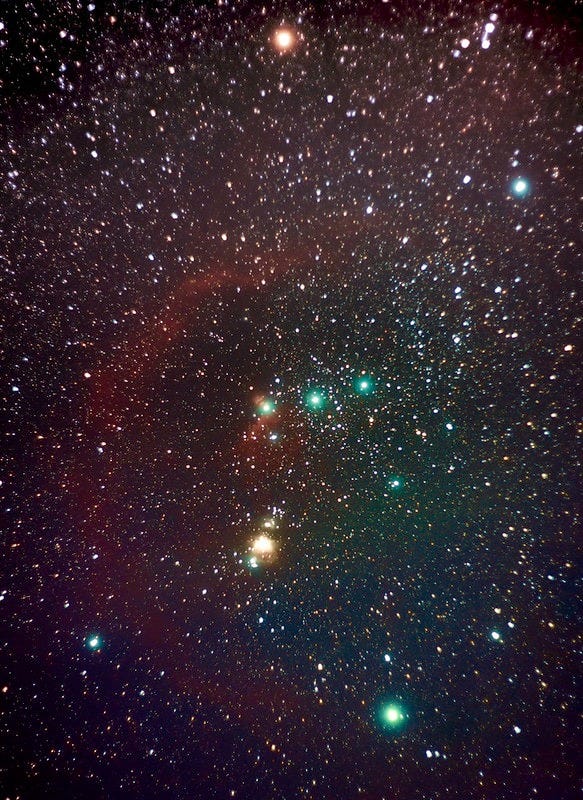
Betelgeuse, the red giant
It’s worth mentioning a bit more about Betelgeuse - a vast red giant star that’s close to its end of life at which point it will explode in a spectacular supernova. And it really is vast - if Betelgeuse were to swap places with our sun, it would extend beyond the orbit of Mars, swallowing everything up in its fiery bulk. Whilst it’s not that likely to happen in our lifetimes, scientists have observed recent signs such as the ‘great dimming’ of 2019 which indicate it’s ready to blow very soon (cosmologically speaking). This will indeed be a spectacle - some estimates claim the supernova could be as bright as the full moon and make our night skies appear like an alien planet, with twin moons adorning the heavens - if only for a few weeks.
Orion itself is a bit of a cosmic microcosm, if you’ll pardon the expression - recognisable stars with a range of hues, a grand nebula visible to the naked eye (The Orion Nebula or M42 to give it its proper name), and an assortment of less obvious nebulae such as the Horsehead Nebula, the Flame Nebula and the Running Man, which can be revealed through long-exposure photography. The Orion Nebula, forming the ‘sword’ of the Hunter, is a great target to view in binoculars or a small telescope. It’s visible with the naked eye but with a bit of magnification will clearly show its eagle-like shape; photographs will then reveal the red and blue colours of the gas and dust that form the clouds surrounding the stars within.


What is a nebula?
Latin scholars will immediately recognise the word nebula meaning ‘cloud’ - though these are anything but atmospheric phenomena. Rather, they’re like interstellar nurseries - huge gatherings of dust and gas where gravity is slowly working to combine clumps into, well, larger clumps. These in turn combine to make ever larger objects, finally culminating in enough mass to trigger nuclear fusion - and a star is born. Sometimes nebulae are formed at the end of a star’s life too, in the form of supernova remnants such as the Crab Nebula, when the star’s matter is blasted far into space to form regions of stuff spanning many light years. The Crab Nebula itself is a remnant of a supernova observed from Earth by Chinese astronomers in the 11th century.
The Pleiades (or Seven Sisters)
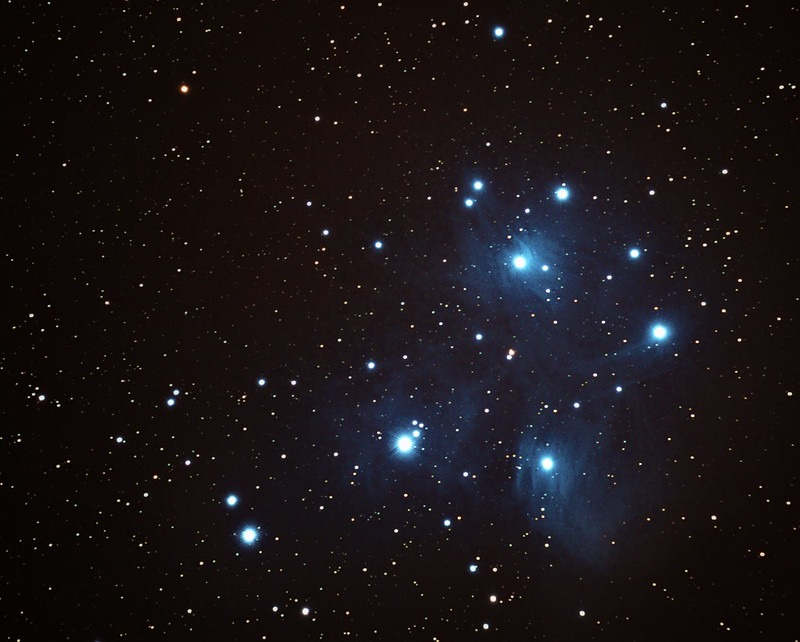
Another familiar sight to many, the Pleiades (or M45) is an open star cluster located in the constellation of Taurus, and is clearly visible high in the south-east throughout December. To the naked eye it’s like a misty collection of fairly faint stars (keen eyes and good conditions should make out seven of them); binoculars will reveal some nebulosity around those stars and several dozen more of them. Here we see the stellar nursery in action - the gas and dust are well into their formation of several stars with a distinct blue hue to them, all having similar brightness. Young stars will usually appear blue as they burn fiercely in their early years, becoming yellow / white over time and eventually turning red as they reach the end of their life. The stars in the Pleiades are thought to be around 100 million years old - whippersnappers compared to our own sun who stands at around 4.5 billion years - and twice as hot.
What are all these ‘M’ numbers?
Charles Messier (1730 - 1817) was a French astronomer solely, it seems, interested in observing comets. He’s now most famous for cataloguing objects in the heavens that were NOT comets, and therefore got in the way of his observations, so that he knew to avoid them in future sessions. As a result he discovered and catalogued 110 nebulae, galaxies and star clusters, with designations from M1 to M110 - nomenclature in use by amateur and professional astronomers to this day.
Planet Watch
Jupiter is currently rising late in the evening and can be spotted to the upper-left of Orion. It’s the brightest object around (other than the moon of course) as Venus is presently too close to the sun, so should be unmissable. Point your binoculars at this gas giant and you may be able to make out the Galilean moons Io, Europa, Calisto and Ganymede as tiny pinpoints of light surrounding the larger planet.
Saturn is well-placed this winter, appearing due south at around 7pm in mid-December. You may be able to discern its rings using binoculars but a small telescope would most likely be able to pick these up. Also see if you can spot its largest moon Titan, though this is likely to be far less interesting than the rings if you haven’t spied them before!
Uranus is a tricky one to spot but it’s conveniently situated close to the Pleiades at the moment. Look to the lower-right of this cluster and try and spot two stars of similar brightness, with a third making up a thin triangle. If you think you can make out a pale turquoise hint to one of those three points, that is more than likely Uranus itself. If you have a pair of 10x50 binoculars, you should just about be able to fit both the Pleiades and Uranus in the same field of view which might be a useful way to find it.
A general hint about spotting the planets is that they don’t tend to shimmer in the way that stars do. This is because their reflected light is far less susceptible to atmospheric disturbance than the light emitted by stars. The immense distances to the stars means that even under high magnification they still appear as a single point, whereas the planets will show a clear disc through a telescope. That additional area of light being transmitted makes their light more stable as it passes through Earth’s atmosphere - hence we see them as more static objects compared to the twinkling stars gracing the sky.
Comet 3I/ATLAS - famous for being suggested as a possible intergalactic spaceship before sense prevailed - is one for the night owls as it rises after 11pm in mid-December, just below the constellation of Leo. At the time of writing it will require a telescope to make anything out, but keep an eye in this area as comets are notoriously unpredictable when it comes to their visibility. The comet makes its closest approach to Earth on 19th December so in the unlikely event it does become a naked eye object, it’ll perhaps be mistaken for Santa’s sleigh instead of the aforementioned alien transporter.
Photographing Star Trails
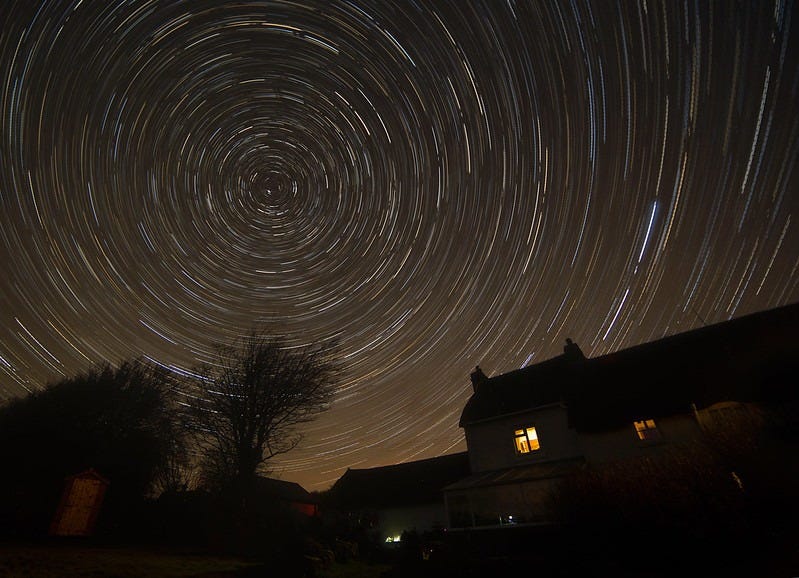
Astrophotography can involve complicated set-ups and very expensive equipment - but at its simplest it can be done with a tripod and any camera that can take a long exposure. Here let’s delve into the simplest of these - star trails. This just involves setting up your camera on a tripod and locating the pole star, Polaris - found by looking due north between Ursa Major (the Big Dipper) and Cassiopeia (with a distinctive ‘W’ shape). Follow the last two stars of the ‘pan’ of Ursa Major in a straight line and Polaris is the next bright start along. If you keep Polaris exactly in the centre of your field of view you’ll see concentric rings as the earth turns on its axis, or you can opt for different effects by moving the pole star slightly off-centre. The best compositions will keep some interesting landscape in the foreground - though bear in mind that to get a full display of trails you’ll need to leave your camera outside for several hours!
If your camera supports it, you’ll want to schedule a sequence of photos taken over as long a period as you (and your battery) can manage. I’d suggest a wide-angle lens fully open at (say) f2.8 or f4, taking 2 - 8 minute exposures using an ISO between 400 and 1600. But please experiment as this will depend a lot on your own equipment. If possible you’ll want to ensure every exposure is as close to the previous one as possible - when you combine these images together later, any gaps between exposures will show up as dotted lines rather than neat trails! This can be overcome by slightly rotating each image in your editing software to overlap the gaps, but it’s a bit of a painful process. Or if you’re using Photoshop you can try using the Radial Blur tool to overcome this problem - a detailed guide can be found here.
Recommended gear
Warm clothes and a hat Whilst it’s obviously pretty chilly at night in winter, don’t underestimate how cold you can get whilst standing still, especially if you’ve travelled out to the moor and can’t easily grab an extra layer.
Red-light torch You’ll likely need some sort of torch to make your way into the garden, at least - but if you use a standard white light torch that will instantly wreck any night vision you may have built up in the dark. Not so with red light, which allows you to see your way around whilst still keeping astronomical sights visible.
Lightweight binoculars A common saying among budding astronomers is ‘the best equipment to own is the equipment you actually use’. Preferably binoculars with a wide aperture but not too much magnification, as these will give you much more light onto your retinas without being too heavy to hold steady whilst looking up.
Sun lounger or reclining chair Standing outside looking up is all well and good but you’re inviting yourself into the world of neck strain, especially when using binoculars. Extend your observation periods by lying back. Bring a mug of hot chocolate whilst you’re at it.
Recommended reading
Turn Left At Orion by Guy Consolmagno & Dan M. Davis. Turn Left at Orion: Hundreds of Night Sky Objects to See in a Home Telescope – and How to Find Them: Amazon.co.uk
Recommended apps for iOS and Android
Stellarium Mobile (Free with in-app purchases) - the most realistic representation of the night sky. My personal favourite.
SkySafari (Various prices) - a range of apps at different price levels with different features ranging from armchair stargazer to full professional telescope control.
Star Walk 2 (Free with ads) - a must-have starter app with excellent visual representation of the constellations.
My Aurora Forecast & Alerts (Free) - get instant alerts when the Northern Lights are likely to be visible in your area tonight.
 |
|
Really enjoyed the balance between accessibility and technical detail here. The Betelgeuse section is fascinating, especially the idea that we might witness a supernova in our lifetimes (cosmologically speaking). I tried doing star trails a couple years ago and totally underestimated the cold factor, so the gear recommendation about warm clothes is spot-on. One thing I struggled with was findign Polaris initially without a clear reference point. The Big Dipper method helps but takes practice in areas withoutmuch ambient light. The smartphone app suggestions at the end are genuinely useful for anyone starting out.